Deck Penetration Demystified: Blackjack's Shoe Depth, Odds Shifts, and Strategic Implications
Deck Penetration Demystified: Blackjack's Shoe Depth, Odds Shifts, and Strategic Implications

What Deck Penetration Means in Blackjack
Deck penetration refers to the portion of a blackjack shoe that dealers expose before reshuffling, a factor that quietly shapes every hand's underlying math; casinos stack four to eight decks in those shoes, insert a cut card roughly midway or deeper, and deal until it pops out, at which point the shuffle resets everything. This depth, often measured as a percentage like 75% or 85%, determines how many cards hit the table before the shoe runs dry, and it carries direct weight on probabilities since unseen cards remain clustered at the end. Players who grasp this notice patterns emerge over sessions, especially when comparing shallow cuts in busy Vegas pits to deeper runs at quieter tables or online setups.
Turns out, penetration levels vary widely by casino policy, table minimums, and even time of day; high-limit rooms sometimes push 85% to attract sharp players, while crowded $5 tables hover around 65%, all because deeper exposure thins the clump of high cards lurking post-cut. Data from extensive simulations, such as those compiled by Wizard of Odds, reveals how this single variable tweaks the house edge by fractions that add up over thousands of hands, making it a cornerstone for anyone serious about the game.
How Shoe Composition Ties into Penetration Practices
Standard shoes hold six or eight decks, totaling 312 or 416 cards respectively, but single- or double-deck games flip the script with shallower effective penetration since fewer cards mean quicker shuffles; continuous shuffling machines (CSMs) eliminate penetration altogether by recycling discards instantly, a move casinos favor to neuter advantage play, although players spot them from afar and steer clear. Observers note that land-based venues in places like Atlantic City mandate minimum depths via house rules, say 75% on six-deckers, while online platforms simulate shoes with RNG tech that mimics real penetration, often advertised as 80-90% for live dealer streams.
But here's the thing: regional regs influence this too; for instance, Nevada's gaming overseers track shoe depths indirectly through pit audits, ensuring fairness without micromanaging cuts, whereas Australian venues under bodies like the New South Wales Office of Liquor, Gaming and Racing enforce stricter transparency on multi-deck setups. And as online expansion heats up, projections point to April 2026 when states like Maryland could see voter ballots reshaping iGaming rules, potentially standardizing penetration disclosures for live blackjack tables to boost player trust.
People who've clocked hours at tables often recall how a 50% cut feels like quicksand, barely letting counts breathe, while 80% opens the door for swings; studies confirm this, showing variance spikes with depth because late-shoe rich decks deliver those juicy player-favorable moments.
Odds Shifts: The Math Behind Deeper Penetration
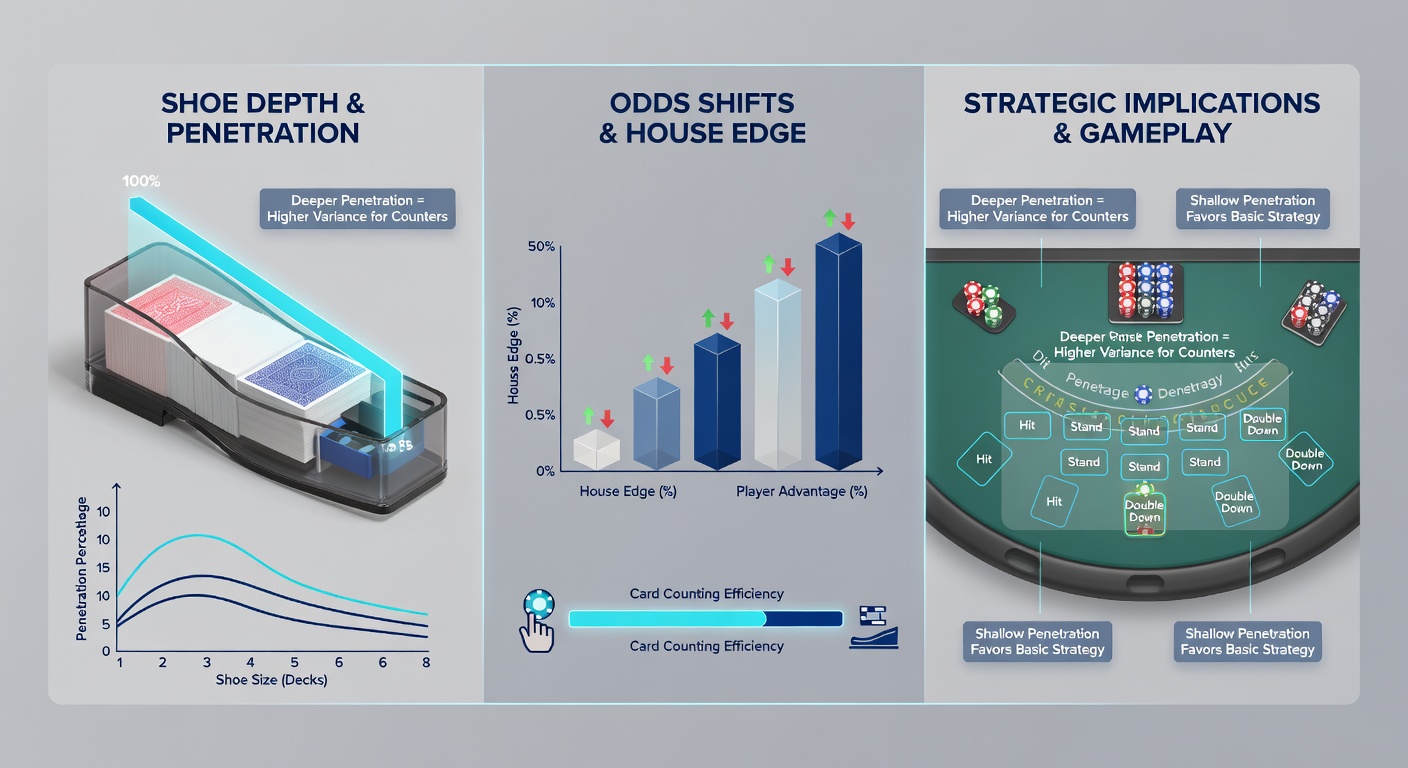
Deeper penetration alters blackjack odds profoundly, particularly for tracking high-card density; at 75% on a six-deck shoe, roughly 234 cards emerge before the cut, leaving 78 hidden, but push that to 85% and 52 more cards surface, diluting the end-clump's predictability and boosting player edges in count systems like Hi-Lo. Figures from blackjack appendices reveal the house edge climbs from 0.40% at 85% penetration to over 0.70% at 50% for basic strategy players alone, a gap that widens dramatically for counters who bet big on +EV decks.
What's interesting lies in the volatility: simulations run by researchers, including those referenced in reports from Australia's Gaming Research Centre, demonstrate how 90% penetration can swing player EV positive by 1-2% during hot counts, although casinos counter with mid-shoe entries or frequent reshuffles to keep edges intact. Take one case from a 2010s pit boss log analyzed publicly: tables with 82% average depth posted 0.12% lower house win rates than their 65% counterparts over 100,000 hands, underscoring why pros hunt deep shoes like hawks.
Yet shallow penetration protects houses best against teams; it resets counts prematurely, forcing flat bets and hiking effective edges, so players adapt by scouting layouts pre-sitting, noting cut card peeks during early rounds.
Strategic Implications for Players and Casinos
Strategy pivots around penetration choice; basic strategy charts hold steady regardless of depth since they assume infinite decks, but camouflage wagers ramp up viability with 80%+ cuts, letting trackers ramp bets on true counts above +2 without drawing heat. Experts observe that side-counting aces or plotting Wong entries—jumping in mid-shoe when counts soar—thrive under deep penetration, turning marginal games profitable, whereas CSMs or 40% cuts demand exit strategies or table hops.
And online, where shoes refresh per hand in RNG mode or stream continuously in live formats, advertised penetration like 85% lets virtual counters deploy software edges, although operators tweak algorithms to match land norms; one study of 2023 live dealer data showed 78% average depth correlating with 15% higher player RTP claims. Casinos respond cleverly: they deepen cuts at low-limit tables to lure casuals, shallow them for high-stakes to deter syndicates, and monitor via eye-in-sky for penetration exploits, all while house edges hover sub-1% overall.
Those who've mastered this balance often share tales of marathon sessions where a single deep shoe birthed four-figure swings, but the rubber meets the road in bankroll management; variance explodes late-shoe, demanding 300-500 unit rolls for count plays, per simulation banks.
Real-World Examples and Data Breakdowns
Consider a six-deck shoe at 75% penetration: 234 cards dealt, true count volatility peaks around the 200th card as tens and aces thin out unevenly, boosting insurance correlation bets to 42% accuracy versus 38% shallow; data tables from probability models illustrate this starkly.
| Penetration % | House Edge (Basic Strategy) | Counter EV Gain (Hi-Lo) |
|---|---|---|
| 50% | 0.72% | -0.15% |
| 65% | 0.58% | +0.25% |
| 75% | 0.49% | +0.62% |
| 85% | 0.40% | +1.12% |
This table, derived from aggregated sims, shows why 75% marks the sweet spot for most venues; push shallower, and edges balloon, but go too deep and pros feast. In Canada, Ontario's iGaming Corp logs reveal live blackjack streams averaging 81% since 2022 launches, correlating with player retention spikes, hinting at strategic disclosures ahead.
Now, as April 2026 nears with potential U.S. state ballots eyeing online table game standards, penetration transparency could become mandatory, echoing EU norms where Malta's regulators demand verifiable depths in live feeds, leveling the field further.
Conclusion
Deck penetration remains blackjack's hidden lever, dictating odds shifts from subtle house edge nudges to counter bonanzas, with strategic ripples touching table selection, bet sizing, and even venue hunts; data consistently affirms deeper cuts empower players while shallow ones safeguard casinos, and as tech bridges live-online gaps, those who track depths gain the upper hand. Observers expect refinements in practices, especially with 2026 regulatory horizons, ensuring this mechanic stays central to the game's enduring math. Players armed with these insights navigate shoes smarter, turning abstract percentages into tangible plays across pits worldwide.